Categories
Announcement & Hot Topics Safety

Winter Truck Maintenance: Keeping Drivers Safe When Temperatures Drop

Winter brings some of the most challenging conditions truck drivers face all year, including icy roads, freezing temperatures, reduced visibility, and increased wear and tear on equipment. Proper winter truck maintenance isn’t just good practice; it’s essential for safety, reliability, and preventing costly downtime. Whether you’re an experienced driver or new to winter driving, preparing your truck before the cold hits can make all the difference

Winter Survival Kit

In case of an emergency or breakdown, keep a winter survival kit that should include:

  •  Shovel & ice scraper
  •  Bag of sand, salt, or litter
  •  Jumper cables
  •  Flashlight
  •  A high-visibility jacket
  •  Winter gloves & boots
  •  Warm blankets & extra clothing
  •  Extra food & water

Winter Truck Inspections: What to Watch Closely

Thorough pre and post-trip inspections matter year-round, but they’re critical during winter.

Cold weather affects nearly every part of your equipment, so pay extra attention to:

  1. Tires – Check wear, pressure, & balance. Cold air causes pressure drops; monitor closely.
  2. Wiper Blades – replace worn blades and make sure wipers can clear heavy slush and ice.
  3. Fluids – Check coolant, oil, windshield fluid, and fuel levels often.
  4. Defrosters – Confirm your defrosters are functioning properly for safe visibility.
  5. Keep equipment clear – remove snow from lights, mirrors, windshields, and steps. Buildup affects visibility, traction, and safe vehicle operation.

Idle-Free Heater

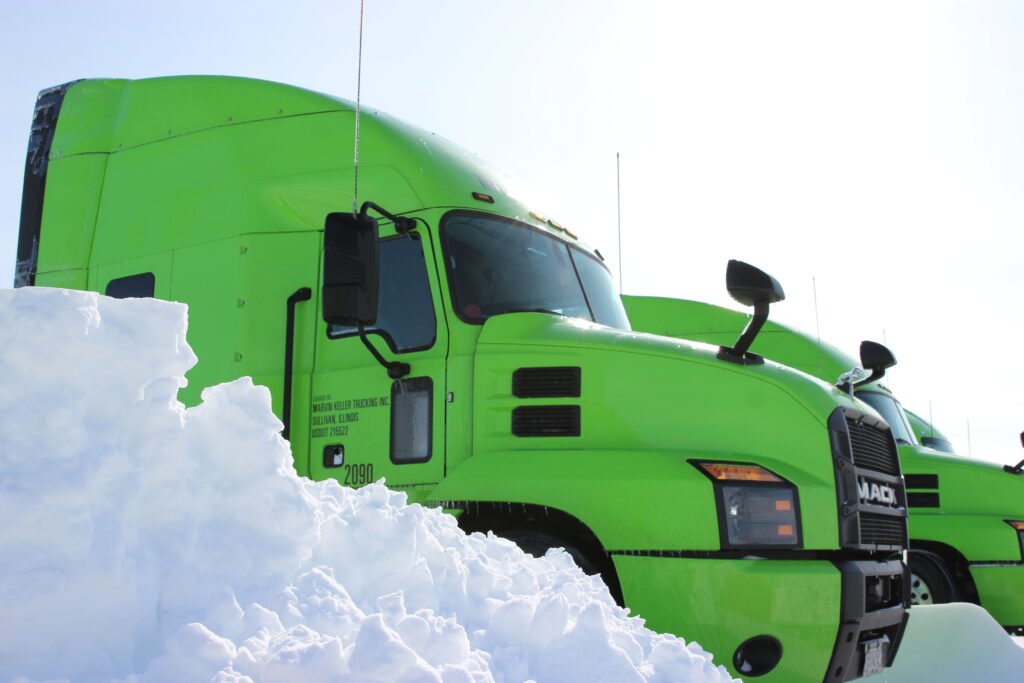
Our trucks are equipped with shore power, which charges the batteries and powers the Idle-Free Heater. This helps to keep the coolant warm and provides warmth during idle times. With a fully charged battery, our Idle-Free Heater can run for about a week.

If you cannot plug in, turn the Idle-Free heater on but leave the fan off; it will serve as a block heater.

Trucks have a main disconnect switch located by the driver’s seat. If you plan to be away from the truck for more than a couple of days, turn off the switch to shut off all power. The Idle-Free heater will still run to keep the coolant warm.

Preventing Frozen Brakes

Frozen brakes are a common winter issue, but are preventable with the right steps:

  • Before parking, lightly drag your brakes to build heat and evaporate moisture. This helps prevent freezing.
  • If brakes are already frozen:
    • Tap the brake drums with a heavy hammer to break up ice.
    • Rock the trailer gently, if possible, to free stuck components.

Winter weather doesn’t wait, and it doesn’t forgive unprepared equipment. Taking a few extra minutes to inspect, clear, and prepare your equipment can prevent breakdowns, protect your load, and keep you safe on the road.

If you ever have questions or notice issues with your equipment, please contact your DM right away. Your safety always comes first.
Categories
Announcement & Hot Topics

Want to Change the Culture?  Here’s How.

In this increasingly digital, impersonal world, it often seems that no one knows how, or cares, to make human connections anymore. Seemingly gone are the days of a friendly wave to a fellow driver or an offer of help without being asked. Here are some reasons for the decline in common courtesy we see today.

The Rise of Digital Communications –

  • Social media and other online platforms, often touted as great ways to interact with others, have paradoxically created a generation of people who have no idea how to interact face-to-face with others. Online anonymity can lead to the airing of ideas that some would never say in person. Becoming accustomed to this kind of unrestrained speech can lead to some to be impersonal, impolite, or even rude when dealing with others in in-person interactions. The digital world has also lowered our attention spans. Think of a time you were having a conversation and felt the need to tune out and check your device. It happens more often than you might think.

Fast-Paced Lifestyles

  • It’s easy to get caught up focusing only on your next task at hand, running through everything you have to do next and just focusing on getting to that point. This isn’t Mayberry, after all. Business must move quickly to survive, but constantly focusing on your busy schedule can lead to neglect of those around you and diminish your personal connections. Studies have shown that taking time to smell the proverbial roses can benefit you by lowering stress and increasing happiness.

Cultural Changes

  • Evolving cultural norms and expectation have placed more emphasis on the individual and self-esteem at the expense of traditional communal values. This can lead to self-absorption and a lack of consideration for others, as well as social ineptitude and impoliteness.

The Increasing Ubiquity of AI

  • AI is everywhere now, and it’s replacing people in many situations. As a planner, I’ve recently booked loads with AI robots over the phone. They sound much like humans and can do almost anything a human can over the phone, minus the humanity and grammatical errors. While we can see the value they bring to a company, dealing with robots can certainly diminish one’s ability to interact with actual humans in the real world.

When everyone else seems to have their eyes glued to their devices, here are some ways you can bring some humanity and common nicety back to your world.

Practice Active Listening

  • This involves ignoring distractions and paying undivided attention to someone when they are speaking, actively absorbing what they are saying, acknowledging their input and providing feedback.

Use Basic Manners

  • Simply being polite by saying “please” and “thank you” can make a big difference in showing appreciation. Maintain situational/social awareness by thinking about how your actions affect others in public spaces. You can also show courtesy by respecting others’ personal spaces.

Practice Patience and Understanding

  • Sometimes it’s difficult to be patient, especially in stressful situations, but having control over your emotions and behavior and being considerate to others during trying times can go a long way to diffusing anger and handling tough situations. Anger and impatience don’t solve problems, they just exacerbate them.

Perform Random Acts of Kindness

  • Offering support to another driver struggling to get hooked or get backed into a dock or giving directions or suggestions can have a big impact on someone else’s day, and it will increase your own happiness and wellbeing.

Small action and positive interactions will strengthen company culture if they are turned into daily habits. These actions are contagious; if you want to change the culture, lead by example.

Categories
Announcement & Hot Topics Performance

Can MK Count On You?

It goes without saying that skills and expertise are important to your employer. Every company wants to ensure employees have the knowledge and skills to effectively do their jobs. But following through on your commitments, meeting deadlines, and being consistent is just as important. Both reliable and unreliable employees create ripple effects within their companies. One leads to effective customer management, growth, and success, with the other leads to lost opportunities, high turnover, and a damaged reputation. Here are some of the behaviors of reliable employees and tips on how to be more dependable at work.

Traits of Reliable Employees:

Punctuality/Time Management – This is absolutely essential in trucking. If you can’t (or won’t) trip plan or make your appointment times, this is an indication that you aren’t managing your time well. We understand that some trips are tightly planned and things happen on the road, but regular patterns of tardiness or bad time management are a concern.

Accountability/Ownership – Own your mistakes, back up your decisions, and accept the results. When problems arise, ask yourself “Was there something I could have done to prevent this?” Taking accountability builds trust.

Performance Consistency – Predictability HELPS US PLAN. We can better keep drivers moving when we can rely on the drivers to be where they are supposed to be when they are supposed to be there. Those who are consistently on time, provide good ETAs, and run without overbreaking or constantly stopping are the ones who get more miles and make more money. In short, if you prove yourself to be unreliable, we can’t count on you and we can’t plan ahead.

Effective Communication – Let us know what’s going on, especially if you know ahead of time that there will be issues. The sooner we know about a potential problem, the sooner we can fix it before it becomes a major issue.

Following Company Policy – if you are unsure of company policy, consult your company handbook or ask your manager; ignorance is not a good excuse.

How to Show Dependability:

Meet deadlines WITHOUT reminders – Aside from appointments, this can include expirations: medical card, license, endorsements, etc.

Take initiative/problem solve on your own first – Show that you don’t need constant supervision. Dependable employees don’t need micromanagement. Don’t just point out problems, introduce solutions! This shows you care about the company’s success beyond just everyday transactions.

Support your team – Putting team success ahead of personal successes shows reliability and helps build trust. It shows you are committed to the success of the company, which benefits everyone.

Stay organized and focused – Staying organized will help you maintain reliability; keeping track of all your tasks and ensuring they are completed timely is a major indication of your reliability.

Adapt to changes and maintain a positive attitude while doing so.

Dependable employees become irreplaceable employees – Building reliability and trust is how you become indispensable, an employee your company can’t afford to lose. Being an employee that doesn’t need to be micromanaged frees up time for companies to focus on growth and expansion, leading to greater overall success.

Categories
Announcement & Hot Topics Performance Technology

Video – Creating DVIRs in Samsara

In this video, we show step-by-step how to create DVIRs for the truck and trailer in the Samsara app, including how to mark and resolve defects.

If you have any questions, please reach out to your DM!

Categories
Announcement & Hot Topics

Are You a Good Representative For Your Company?

Your actions, professional and personal, DO affect how your company and associates are perceived. Almost no one can remain anonymous anymore. The ubiquity of smart phones and social media has allowed for every facet of a person’s life to become public. The consequences of bad personal character on company reputation can be far-reaching. Here are some actions that indicate poor character.

Negative Reviews

If you’ve ever taken a look at a job-posting board, you will notice a section with company reviews, written by former and/or current employees. Those reviews certainly have an effect on one’s willingness to apply to or work with said company. Always take into account what you say about a company. Are you speaking from a point of rationality or emotion? Scorned former employees may think they’re getting even, but they rarely consider that future employers can see how they act with previous employers and take that into considering when hiring. Are you exhibiting an image or professionalism or pettiness? Your actions in the personal and social sphere will reflect upon your conduct and reliability in the professional world.

Inappropriate Content, Cyberbullying, or Harassment

Maintaining a professional and courteous social presence can be crucial to the reputation of your company. You may think that your actions in your personal life and professional life should be mutually exclusive. While that may be the ideal, it just doesn’t work that way. What happens in your personal sphere, especially in the exhibitionism of modern social media, nothing stays in the dark. It’s easy to think that your personal behavior is your own business, but keep in mind that everything you do and say also reflects upon your company, for bad or good. The character of a company is built and maintained by the actions of its employees and leaders. It can take years to build a good reputation but sometimes only a single bad decision to ruin one.

Repercussions of Poor Character

Loss of Customers or other Business Opportunities

Reputation is everything; research has shown that close to 90% of customers read company reviews online before making purchasing decisions. It follows that larger customers do the same research when looking into trucking companies to hire.

High Employee Turnover and Recruiting Difficulty

As a driver, you come into contact with lots of other drivers, from within and outside of, the company. Showing integrity and good personal character is a great way to recruit as it shows other drivers who may want to find a new company what they can expect.

How to Foster Good Character in Employees

Employers should focus on creating a workplace where employees are comfortable sharing feedback with managers as opposed to public displays of grievance. Not only does this allow the company to address issues in a constructive manner but it also avoids opportunities for reputations, of both company AND employee, to be damaged in a fit of anger.

Employers should also set clear expectations in regards to employee behavior. Because drivers are the public face of the company, so to speak, it’s essential that managers should outline what behaviors are acceptable in order to maintain a positive environment and good reputation. Always keep in mind, you never know who may be watching your behavior and associating it with your company.

Categories
Announcement & Hot Topics

Taking Initiative: The Power of Problem-Solving on the Road

Professional drivers face new challenges every day, such as weather changes, tight delivery windows, unexpected detours, or equipment issues. While no one can predict what the road will bring, what sets great drivers apart is their ability to take initiative and solve problems independently while keeping safety and professionalism at the forefront.

Be Proactive, Not Reactive

The best time to solve a problem is before it starts, and that begins with preparation. Taking initiative means anticipating challenges and setting yourself up for success before you ever hit the road.

Trip planning

Trip planning is one of the most important habits of a professional driver. Before you start your day, review your route; check the weather and traffic, and plan safe, legal parking, fuel, and rest stops, with backup options in mind. Careful planning gives you flexibility when things don’t go as expected and helps prevent last-minute, stressful decisions.

Pre-Trip Inspections

Inspecting your equipment before you roll out helps identify potential issues early, reducing the risk of breakdowns or delays later in the day. Addressing small problems before they become big ones keeps you on track and your truck in top shape.

By thinking ahead and preparing for what could happen, you stay in control and avoid unnecessary setbacks. A few extra minutes spent planning and inspecting can save hours of frustration down the road.

Stay Resourceful When Challenges Arise

Even the best-laid plans can change on the road. When faced with an obstacle, pause and assess your options before reacting. Think: What can I control right now? Being resourceful might mean finding an alternate route, contacting dispatch with clear details, or making a safe, temporary adjustment to your plan. Your ability to stay calm and solution-focused helps keep freight moving and ensures safety remains the top priority.

Communicate Clearly and Confidently

Taking initiative doesn’t mean doing it all alone. Strong problem-solvers know when to reach out for support. Communicating quickly and clearly with your Driver Manager, Maintenance, or Safety team can make a big difference.

For instance, some drivers have shared challenges finding parking near shippers or receivers late in the evening. Because they spoke up, Driver Managers were able to secure parking closer to their destination, preventing early shutdowns.

When reaching out, share facts, not frustrations — what’s happening, where you are, and what you’ve tried. Clear communication builds trust and helps your team respond efficiently.

Learn from Every Situation

Each challenge you face on the road is an opportunity to grow. Reflect on what worked, what didn’t, and how you can apply that lesson next time. Over time, this mindset builds confidence and independence, qualities that make you a stronger, more capable driver.

Represent Professionalism Through Action

Taking initiative and solving problems the right way not only helps you succeed but also strengthens the entire team. When you lead by example, others take notice. Whether you’re mentoring a newer driver or representing the company on the road, professionalism and proactive problem-solving show pride in your work and respect for the industry.

Remember: Every challenge is a chance to demonstrate your skill, patience, and professionalism. By thinking ahead, communicating effectively, and staying resourceful, you help ensure success for yourself, your team, and the entire company.

Categories
Announcement & Hot Topics

Driving Toward Success: Increasing Daily Drive Time

Every mile matters, not just for moving freight, but for driving our shared success. Time on the road is what keeps our customers satisfied, our schedules on track, and our paychecks growing. That’s why we’re placing a stronger focus on increasing daily drive time across our fleet.

We’re currently reviewing average drive time and working with drivers who consistently drive less than eight hours a day to identify opportunities for improvement. This isn’t just about numbers; it’s about efficiency, teamwork, and building habits that contribute to everyone’s success.

Why Drive Time Matters

More drive time means more miles, and more miles mean more money for both drivers and the company. Every additional hour behind the wheel brings us closer to meeting customer expectations, enhancing productivity, and increasing overall profitability. It’s a win-win for everyone involved.

Areas of Focus

We’re looking at drive time improvement from all angles:

  • Driver Performance
    Small habits can make a big difference. Getting an earlier start, planning breaks efficiently, and staying proactive throughout the day can help maximize available drive time.
  • Planning & Dispatch
    Our planners are continuously reviewing routes and loads to ensure drivers have the best opportunities to reach their full driving potential each day. We also understand parking can be a challenge and impact drive time. If you’re having trouble finding a safe spot, contact your Driver Manager for help before shutting down early.
  • Shippers & Receivers
    We’re working closely with our customers to minimize detention time and improve loading and unloading efficiency because less waiting means more driving.

Moving Forward

As part of our ongoing improvement efforts, we’ll continue to monitor average drive times and support drivers in reaching their goals. Together, we’ll focus on the factors within our control, both behind the wheel and in our operations, to make every hour count.

When we increase drive time, we all move forward: drivers earn more, customers remain satisfied, and as a company, we continue to grow stronger together.

Categories
Announcement & Hot Topics Performance Recognition

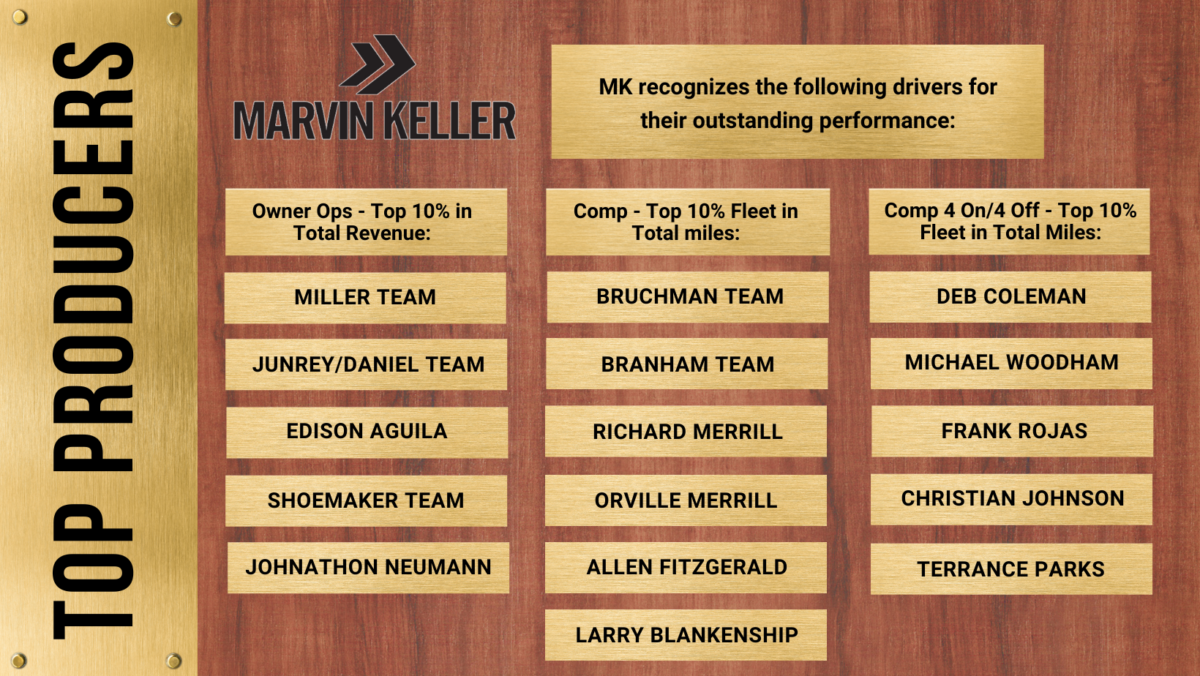
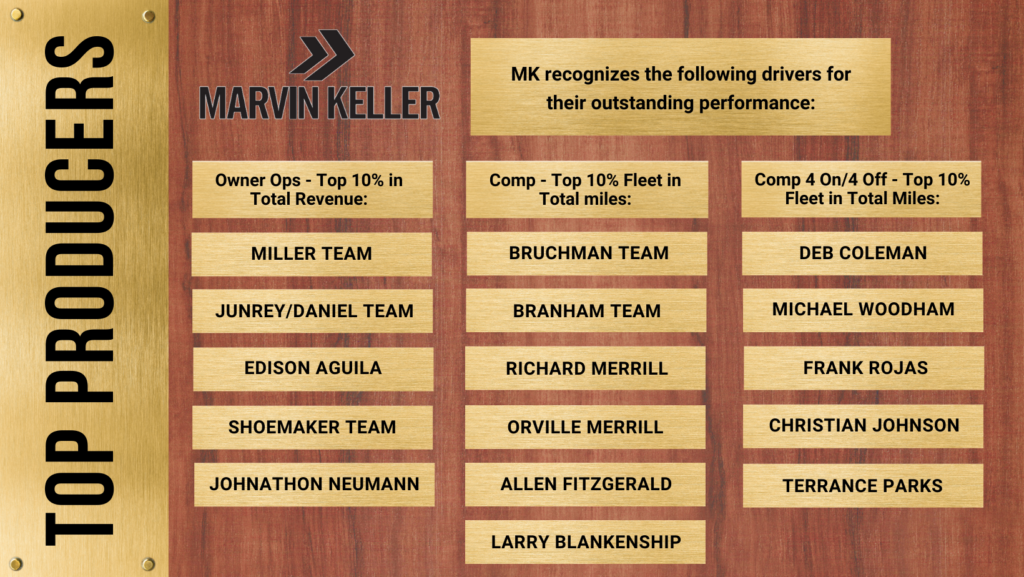
Top Producers of 2025 – Q3

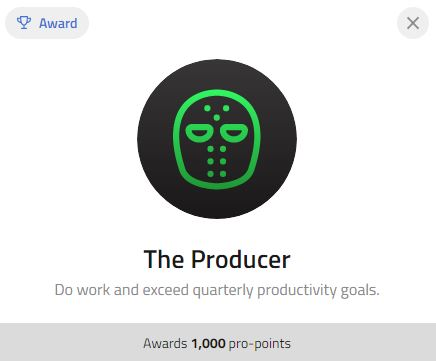
Each quarter, the Producer Badge is awarded to drivers who are in the Top 10% of the fleet in who exceed the quarterly productivity goals. This badge symbolizes the driver’s hard work and success within Marvin Keller.

Congratulations to the following drivers who earned the Producer Badge for 2025 – Quarter 3!!

Owner Operators – Top 10% Total Revenue for the Quarter

  • Miller Team
  • Junrey / Daniel Team
  • Edison Aguila
  • Shoemaker Team
  • Johnathon Neumann

Company Drivers, OTR – Top 10% Fleet in Total Miles

  • Bruchman Team – 40,836
  • Branham Team – 39,514
  • Richard Merrill – 38,638
  • Orville Merrill – 36,863
  • Allen Fitzgerald – 34,227
  • Larry Blankenship – 33,321

Company Drivers, 4 On/4 Off – Top 10% Fleet in Total Miles

  • Deb Coleman – 24,235
  • Michael Woodham – 23,724
  • Frank Rojas – 22,443
  • Christian Johnson – 22,426
  • Terrance Parks – 21,825
Categories
Announcement & Hot Topics

Navigating the Parking Problem: What Our Trainers Want You to Know

Ever pulled into a truck stop at the end of a long day only to find every spot taken? You’re not alone. Finding safe, legal, and convenient parking has become one of the biggest challenges for drivers nationwide. Whether you’re finishing a long haul or taking your mandatory break, proper trip planning can significantly reduce stress and help keep your schedule on track.

To help, we asked our experienced driver trainers to share their best advice. Here’s what they had to say:

1. Always Have Multiple Parking Options

“I always tell trainees to find three parking spots along their route — one about an hour before their projected stop, one at the stop, and one about 30 minutes beyond it. That way, you’re never left scrambling if a location is full,” Brian Doughty

2. Avoid Congestion and Plan Early

Finding parking near large cities can be especially tough. “Truck stops in cities are usually full all day long. I parked in rest areas more than in truck stops,” said Ryan Ernst.

Ryan’s tips to make parking easier:

  • Start early, finish early. The earlier you plan to shut down, the better you’re parking options.
  • Use technology. Apps like Trucker Path (and newer ones on the market) help you locate available spots in real time.
  • Know your options. Some weigh stations and even shipper or receiver properties may allow parking. Be sure to check ahead of time.
  • Always have a backup plan. Never rely on one single location.

3. Plan Ahead — Especially for Late Arrivals

Charity offers strategies for drivers who often park later in the evening:

  • Know your route, distance, and estimated arrival time. Then do a Google search for truck parking in said area.
  • If you’ll arrive after 7 PM and plan to park at a truck stop with reserved spots, reserve your space in advance.
  • Never assume there will be parking available when you get there. Spots fill up faster than ever, especially on weekends.
  • Best Advice: Choose a spot that’s safe, legal, and comfortable with good lighting, restroom access, and enough space to maneuver safely.

To note: if you are having trouble finding parking, our Driver Managers can help reserve a spot. Just ask!

Parking will always be one of the trickiest parts of life on the road, but with planning, flexibility, and awareness, it doesn’t have to be stressful. Take the time to plan your stops, use the tools available, and always prioritize safety.

Categories
Announcement & Hot Topics Uncategorized

Do you have the right personality traits for success?

You reap what you sow, as the saying goes. Those who exhibit positive personality traits are more likely to find positivity and opportunity in return. Conversely, those who think negatively will probably see negativity in everything. Positive traits such as resilience, empathy, and adaptability are important to a successful career. These qualities not only enhance individual performance but also foster a collaborative and productive workplace culture. By embracing these traits, employees and organizations can navigate challenges more effectively and drive long-term success. Here are the traits Marvin Keller is looking for in a driver.

Adaptability

  • Adaptability is the essence of intelligence, the ability to evolve with changing environments and solve problems. Embrace change and focus on what you can control; try to learn new things instead of resisting change, and seize opportunities for growth. Be resourceful, using creativity to find solutions to problems.

Ambition/Self-Motivation

  • Show you are motivated to succeed by exhibiting enthusiasm and a good work ethic.

Friendly/Empathetic

  • Be approachability and express genuine interest in others and be willing to go out of your way to help others.

Honesty

  • Honesty and integrity are important in any job; being able to trust your employees and coworkers creates a more open, transparent atmosphere. Being honest is especially important for drivers. Because we can’t be on the road with you, we have to be able to trust that the information we are given is accurate. Deception with your managers or bosses undermines that trust and you become a target for micromanagement.

Humility

  • Put the team ahead of yourself; consider achievements that others helped with as team efforts. Show that you are interested in the success of the whole company and not just those of the individual. The humble person avoids arrogance and self-aggrandizement. There’s nothing wrong with taking credit for your work, but be modest about it. Hyping your own work at the expense of the team is a bad look.

Optimism

  • See opportunity in adversity and challenges, and always look for ways to improve.

Respect

  • Everyone has different strengths and that is what benefits an organization. If everyone was good at and deficient in the same areas, success of the team would be hindered. Respecting those differences and the contributions of others is integral to team success.

Resilience

  • Carry on, even when things are tough. Being able to recover quickly and powering through challenges makes you a stronger, more successful person.

Dependability/Thoroughness

  • Be dependable in delivering results. This is an easy skill to develop as you just have to do your job and be reliable. Doing so consistently builds trust among your coworkers and bosses and sets you up for success and upward mobility.

Attitudes are contagious. Is yours worth catching?