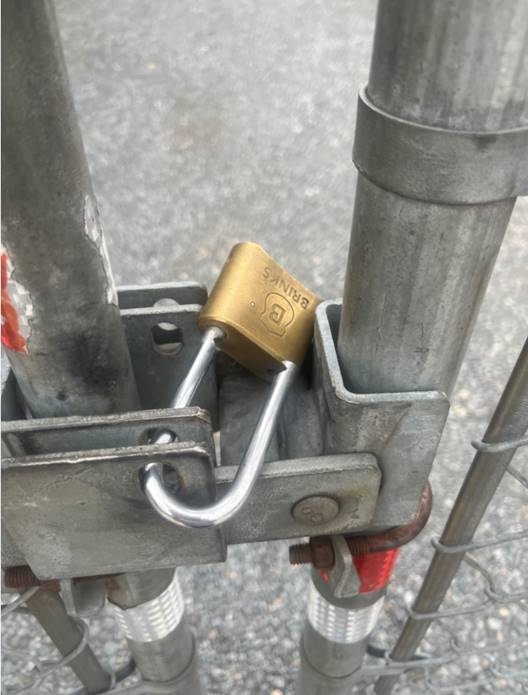
A reminder to all drivers parking at the Richburg, SC yard to lock the gate – not “dummy” locked. They need it to be secured at all times, as they have customer equipment on the yard too.
Below is a picture of what they are seeing. Please do not do this, and lock the gate completely.
Trucks are expensive to operate. Between equipment costs, fuel, maintenance, and repairs, it can be inordinately expensive. So it should go without saying that trucks have to run to be profitable. Here’s what we are focused on to make sure all our trucks remain profitable.
Unplanned Absences
These are defined as any call-off in less than two weeks’ time. Time off must be scheduled in advance with PTO or vacation hours. The reason it’s so important that drivers work their assigned schedule is not just because the trucks have to run to be profitable, but we have made commitments to our customers, and we are expected to pick and deliver when we have committed to do so. When we have unplanned absences, we usually miss pickups and deliveries, which damages our reputation with our customers.
It’s also impossible to make up for downtime, especially when you are running on a 4 on/4 off schedule. We expect our drivers to be reliable; if we can’t depend on you to meet your commitments, we can’t meet ours.
Partnering all 4 on/4 off trucks
In order for these trucks to make money, they must be running all the time. Recruiting is working hard to try to partner up these trucks, but we welcome drivers finding and referring their own driver partners as well. That way, you make money as a recruiter as well through referral bonuses!
It’s also important to do your best to stay on schedule so your partner can as well.
Ensuring drivers are working a minimum number of hours/day and miles/week
Of course, this is all taken in the context of how you’re planning. Drivers are only expected to do what planners and customer service can accommodate, but we are taking a closer looks at overbreaks, unaccounted for on or off-duty non-driving times, and start/stop times.
When driver time isn’t being utilized to its full potential, planners don’t know when to expect you or they can’t count on you to be where/when you need to be to cover customer freight. This results in lost revenue and lower pay for you as well if you’re not maximizing your time.
We also want to utilize spare trucks in cases of breakdowns. This will prevent you from sitting for long periods of time if your regular truck needs repaired.
Making small changes to efficiency and truck utilization can add up to big savings, which will trickle down to you. When the company is successful, you are successful. Help us make 2025 the year we make a great comeback.
Let me ask you a question: Would you keep working if you didn’t make a profit? Let’s say you have to commute a good distance to work, so you take into consideration the cost of your transportation, the gas costs to run your vehicle, the costs of child care while you’re gone, etc. Say you’ve had medical issues and have medical bills piling up, or your house needs maintenance, a new roof, furnace, etc. What would you do? You would either find ways to cut some of your costs, or you would find ways to earn extra money to cover those costs. Ideally, you’d do both. And when things are going well, you put aside some money to save for when things go south. How we run our personal lives is a lot like how businesses run. They have to find ways to cut costs while increasing revenue. It’s been a trying few years for the trucking industry, but the market is coming back, and it’s time for Marvin Keller to start making money again. Here’s how we’re going to do it.
Equipment Costs
Reducing truck idle, including utilizing idle-free systems. This can be accomplished with improved equipment and driver training. MK is always looking for the newest technologies and late-model trucks. Every generation of new trucks comes with new features that increase fuel efficiency. Fuel is the single greatest expenditure MK has, so the smallest improvements account for major savings.
Operational Improvements
Increasing customer rates. For the first time in years, customers are amenable to increased rates. While we’re not looking at doubling rates or anything unreasonable, if we’re able to increase 5 lanes we run 5 times a week by only $50, that accounts for a significant amount over time.
Working on connecting lanes and being strategic about new lanes. Deadhead is a revenue killer; finding ways to get paid to move to our next customer pickup is key to increasing our rate/mile. If we can’t increase lane rates enough to make up for deadhead, we can work on finding connecting loads to each customer pickup to bridge that gap.
Working with customers to gain drop/hook privileges. Sitting is another way to lose money, and it gives us another opportunity to come up with solutions to improve velocity. By working with existing customers to acquire drop/hook lanes and finding new customers who appreciate our ability to leave drop trailers at their sites, we’re keeping trucks moving, earning more money for the company and more money for you! It’s important to note that just like live-load and unload facilities, drop facilities have expectations of our drivers and our equipment. Always read facility notes in your Drive App or load remarks to ensure you are complying with all safety regulations and common courtesy when dropping and hooking. We have lost drop privileges at some facilities due to driver non-compliance, which affects not just you, but the whole team.
These changes are going to happen; we have to push hard to make improvements and be profitable to move the company forward and there’s no better time than the present. We look forward to everyone embracing these changes for the better and reaping the rewards of that effort. Next week: Truck utilization.
We’re transitioning our fuel card provider from Comdata to EFS/WEX. Read the important updates & features of the new provider below. If you have any questions, please reach out to your DM.
Changing Fuel Cards to EFS/WEX
There is a WEX CardControl app so drivers can find fuel locations and prices along your route
Weight and Pay with ease at Cat Scale locations
Drivers will receive their new fuel cards and EFS Money Code checks in the upcoming weeks
No change in the process at the pump except a different card
Each quarter, the Producer Badge is awarded to drivers who are in the Top 10% of the fleet in who exceed the quarterly productivity goals. This badge symbolizes the driver’s hard work and success within Marvin Keller.
Congratulations to the following drivers who earned the Producer Badge for 2025 – Quarter 1!!
Owner Operators – Top 10% Total Revenue for the Quarter
Junrey Montejo & Daniel Nunez Team
Shoemaker Team
Miller Team
Terry Hodge
Johnathon Neumann
Company Drivers, OTR – Top 10% Fleet in Total Miles
Branham Team – 45,564
Richard Merrill – 39,934
Bruchman Team – 39,551
Allen Fitzgerald – 35,207
Orville Merrill – 33,915
Company Drivers, 4 On/4 Off – Top 10% Fleet in Total Miles
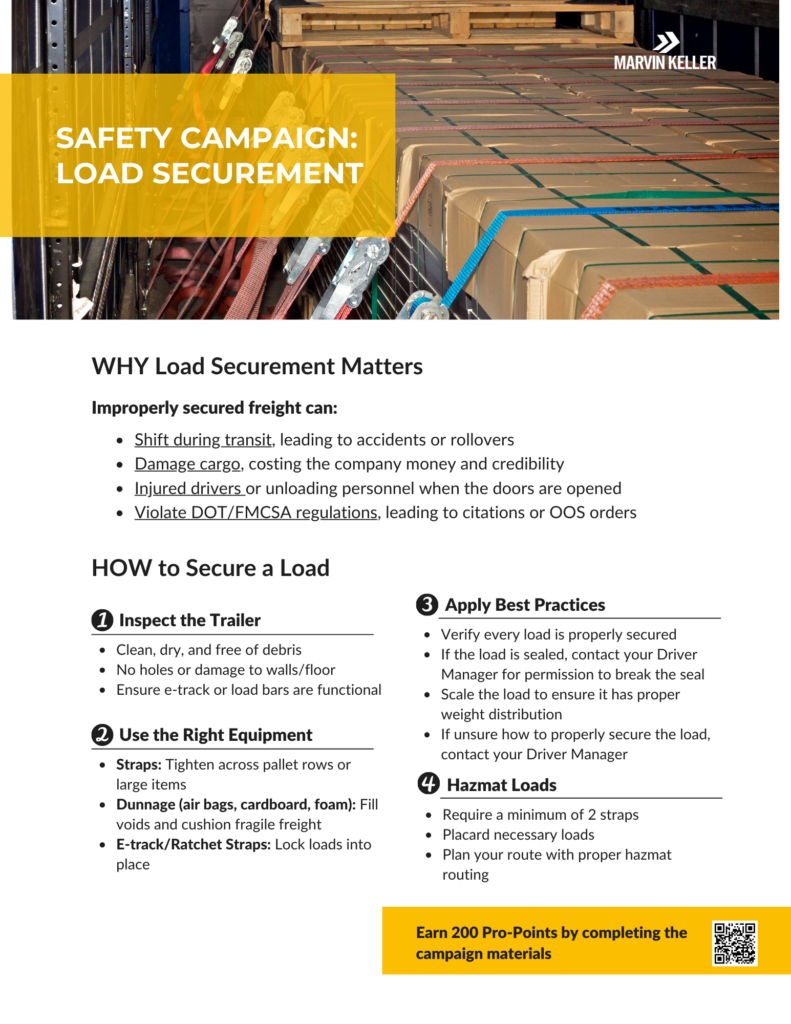
We know you’ve heard us discuss pre and post-trip inspections before, likely more than once. But hear us out. This isn’t just about checklists, rules, or company policy. It’s about what kind of driver you are when no one’s looking. That quick walk around and careful look under the hood says you take pride in your work and says you’re a pro. A solid pre and post-trip routine doesn’t just protect the equipment, it protects you.
Here’s what a few extra minutes buys you:
Healthier Equipment
The truck you inspect today is the one that’ll run better tomorrow. Spotting a small issue early, such as a worn belt, low tire pressure, or loose wiring, can be the difference between a quick fix or a full-blown repair miles from home. When you take care of your equipment, it returns the favor.
Fewer Over-the-Road Breakdowns
There’s never a good time to break down, but there is a better way to prevent it. Catching issues before you leave the lot means fewer surprises on the road, less downtime, less frustration, and more control.
DOT Compliance & Fewer Violations
Proper inspections help avoid CSA (Compliance, Safety, Accountability) points by catching violations before roadside inspectors do. It also helps prevent costly fines and keeps our reputation solid.
Your Safety
No load, no deadline, no shortcut is worth risking your safety. A complete inspection can reveal hazards before they become emergencies. It keeps you and the others on the road safe. That’s something no one should take lightly.
Bottom line?
Pre & post-trip inspections may be routine, but they speaks volumes. We don’t just talk about them because it’s policy. We talk about them because they’re one of the strongest habits of a safe, reliable, top-tier driver. And that’s what we strive for every day.
You matter to this company, and your safety matters even more. That’s why we’ll never stop reminding you to take those 10 minutes for yourself and everyone counting on you to make it home safely.
“The Commercial Vehicle Safety Alliance (CVSA) has announced July 13-19 as this year’s Operation Safe Driver Week, a safe-driving enforcement and outreach initiative aimed at improving driving behaviors through education, traffic-enforcement strategies, and driver interactions with law enforcement.
During Operation Safe Driver Week, law enforcement personnel in Canada, Mexico and the U.S. will be on the lookout for commercial motor vehicle drivers and passenger vehicle drivers engaging in unsafe driving behaviors, such as speeding, distracted driving, following too closely, drunk or drugged driving, etc. Drivers engaging in such behaviors will be pulled over by law enforcement personnel and issued a warning or citation.”